
 (800) 641-7488
Vacant building insurance is designed for houses and commercial properties that are empty, awaiting sale, between tenants or scheduled for future work. Insured ASAP helps property owners compare vacant home insurance and vacant commercial property insurance options from established insurance carriers.
Owning an empty building creates risks that a standard homeowners or commercial property policy may not be designed to cover. A vacant house, storefront, office or warehouse can be more vulnerable to vandalism, theft, fire, weather damage and problems that go unnoticed because nobody is there every day.
Start a vacant property insurance quote online or call (800) 641-7488 to speak with a licensed insurance representative.
Prepared by Insured ASAP Insurance Agency and reviewed for insurance accuracy by a licensed property and casualty insurance producer.
The right policy depends on the building, its condition and what you plan to do with it. Insured ASAP helps property owners compare insurance for vacant homes and commercial buildings, including properties awaiting sale, a new tenant, renovation or a future change in use.
Vacant Building Insurance Explained
Vacant building insurance is specialized coverage for a residential or commercial building that is empty for an extended period. Unlike a standard property policy that is priced and written with normal occupancy in mind, vacant property insurance addresses the different risks created when regular occupants and business operations are no longer present.
Vacancy can also change how an existing policy responds to a loss. Some policies limit or exclude certain losses after a stated period of vacancy. Others define vacancy according to the type of building and how much of it is being used for its customary purpose. The policy language, rather than the everyday meaning of the word, controls.
Contact your current insurance company or agent as soon as you know a property will become vacant. Do not cancel an existing policy until replacement coverage has been confirmed in writing by an authorized licensed representative.
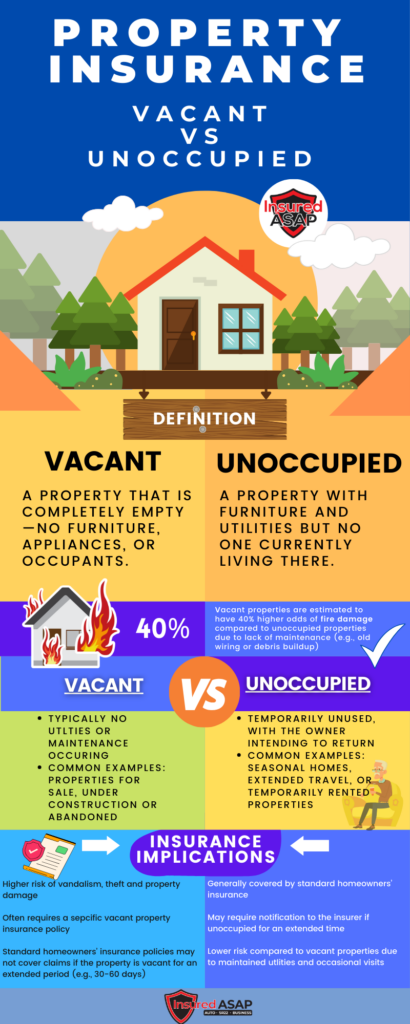
Vacant and Unoccupied Properties Are Not Always the Same
People often use vacant and unoccupied to mean the same thing, but insurance policies may treat them differently.
An unoccupied house may still be furnished, connected to utilities and ready for the owner to return. A vacant house may have no resident and little or no personal property inside. For a commercial building, the policy may consider how much of the premises is being used for normal operations rather than whether someone stops by occasionally.
Tell the agent what remains inside the building, whether any tenant or business activity continues, how the utilities are handled and how often the property is checked. Those details help determine whether the current policy can continue or a separate vacant-property policy is needed.
Why Vacant Property Insurance Usually Costs More
Insuring a vacant property often costs more than insuring an occupied building because losses may be more likely to occur or become more severe before they are discovered.
- Vandalism and theft: Empty buildings may attract break-ins, metal theft and intentional damage.
- Undetected damage: A leaking pipe, roof opening, electrical problem or small fire can cause extensive damage when nobody is present to respond.
- Fire exposure: Delayed discovery and limited on-site activity can increase the potential severity of a fire.
- Premises liability: Owners can face claims involving visitors, contractors, children or trespassers injured at the property.
- Weather-related damage: Heating, winterization and water-shutoff practices can affect the chance of frozen pipes and other losses.
- Building condition: Deferred maintenance, unrepaired damage and older systems can make a vacant building more difficult to insure.
Insurance carriers account for these exposures through eligibility rules, deductibles, inspections, security requirements and policy terms. Price is important, but the covered causes of loss and valuation method can make a major difference in what a policy actually provides.
Vacant Property in Areas with Frequent Crime

Location can affect both availability and price. A vacant building in an area with frequent burglary, vandalism or arson losses may require stronger security or more frequent inspections. Nearby abandoned buildings, limited fire protection and prior losses at the address can also influence underwriting.
Useful controls may include working exterior lighting, cameras, monitored alarms, secured doors and windows, fencing where appropriate, and a written inspection schedule. No single security measure guarantees eligibility or a lower premium, but clear evidence that the building is actively managed can strengthen a submission. Property owners can review public information through USA.gov crime statistics resources.
How to Insure a Vacant Building
The process begins with an accurate description of the property and a realistic plan for it.
- Notify the current insurer. Report the occupancy change and find out how the existing policy treats vacancy. Do not assume coverage continues unchanged.
- Describe the building accurately. Provide the address, construction, square footage, year built, condition, prior use and current occupancy.
- Explain the reason for the vacancy. A building awaiting sale, leasing or planned renovation may be viewed differently from one with no stated plan.
- Compare the policy terms. Review building valuation, covered causes of loss, deductibles, liability, vandalism, theft and water-related restrictions, not only the premium.
- Maintain and inspect the property. Keep the building secured and weather-tight, follow carrier requirements for utilities and heat, and document regular inspections.
Recent exterior and interior photographs are especially helpful. Depending on the property, an underwriter may also request a current declarations page, loss information, an inspection report, a renovation scope, an appraisal or lender requirements.
Vacant Homes and Commercial Buildings We Can Help Quote
Vacant-property markets may consider many kinds of buildings. Eligibility depends on the individual risk rather than the category alone.
Residential buildings
Vacant home insurance may be used when a house is empty during a sale, estate transfer, renovation or extended gap between tenants. Properties that may qualify include:
- Single-family houses
- One- to four-family dwellings
- Estate-owned or inherited homes
- Houses listed for sale
- Rental homes between tenants
- Vacant condos and townhouses
- Completed homes awaiting sale or occupancy
- Investor-owned homes awaiting repair, resale or a new tenant
Commercial buildings
Vacant commercial property insurance may be appropriate when a business building has lost its tenant, is awaiting sale or will remain empty before renovation or redevelopment. Properties that may qualify include:
- Retail stores and storefronts
- Offices and medical offices
- Warehouses and light-industrial buildings
- Apartment and multifamily buildings
- Mixed-use properties
- Strip centers and partially occupied buildings
- Religious, community and institutional buildings
- Lender-owned and investor-owned properties
Prior occupancy matters. A former office, neighborhood store or apartment building presents a different exposure from a former restaurant, nightclub, heavy-manufacturing facility or building with environmental concerns. Disclose the building’s prior use even when it is now completely empty.
Vacant Property Insurance Coverage
There is no single vacant-property policy that fits every building. Property and liability may be written together or through separate policies. The following coverages may be included or available, depending on the carrier, form and property.
| Coverage | What it may address |
|---|---|
| Building coverage | Covered physical damage to the insured structure, up to the selected limit and subject to the deductible and policy terms. |
| Replacement cost or actual cash value | The method used to value a covered building loss. Actual cash value generally accounts for depreciation. |
| Premises liability | Claims alleging bodily injury or property damage arising from ownership of the premises. |
| Vandalism and malicious mischief | Intentional damage to the building when covered by the selected form. |
| Theft or attempted theft | Coverage may be limited or unavailable for building materials, fixtures, copper, equipment and contents. Confirm it specifically. |
| Wind and hail | Covered wind or hail losses, which may carry a separate dollar or percentage deductible. |
| Other structures and contents | Detached structures or owner-owned property when scheduled or included. |
| Equipment breakdown | Certain mechanical, electrical or pressure-system breakdown losses when included or added. |
| Fair rental value or business income | Limited income protection may be available in some situations, subject to the policy and the reason the building is vacant. |
Flood and earth movement are commonly handled separately. According to FEMA, most homeowners insurance does not cover flood damage. Ask about separate flood insurance when the building is in or near a flood-prone area.
Coverage descriptions are summaries only. The quote, application and issued policy determine the actual limits, deductibles, covered causes of loss and exclusions.
Vacant Building Eligibility
Underwriters generally want to see a property that is empty but actively managed, rather than abandoned.
Factors that can help include clear ownership, a specific reason for the vacancy, a plan to sell or lease the property, regular inspections, a weather-tight roof, secured entry points, working protective systems and current photographs. Updated electrical, plumbing, heating and roofing systems may also improve market options.
Some properties need additional review or a specialty market. Examples include buildings with unrepaired fire or structural damage, open code violations, uncertain ownership, occupants or squatters, recent insurance cancellation, repeated losses, major structural renovation, condemned status or a prior use involving higher hazards.
A difficult property is not automatically uninsurable. It usually means the agent needs complete information before approaching the appropriate market. Hiding damage, ongoing work or unauthorized occupancy can result in a quote being changed or withdrawn.
Information That Helps Move a Quote Forward
For an initial review, provide the property address, building value, year built, construction type, square footage, date the vacancy began, prior use and intended future use. Also include the building’s current condition, planned renovations, roof and system updates, security, utility status, prior losses and the liability limit requested.
You do not need to assemble every possible document before contacting us. Start with what you know. A licensed representative can identify the additional information needed for that particular building and market.
Vacant Property Insurance Cost and Recent Quote Examples

Vacant property insurance premiums vary widely. Important rating factors include the property type, location, construction, age, condition, building limit, valuation method, deductible, roof, electrical and plumbing updates, fire protection, security, vacancy length, intended future use and loss history.
A national price chart based only on building value can be misleading. Two buildings with the same value may receive very different quotes because the properties and requested coverage are different. These examples show how actual assumptions affect the result.
Illinois vacant home
Quoted August 21, 2026
1,300-square-foot, one-unit joisted-masonry dwelling built in 1975; protection class 1; five-year-old roof; $100,000 replacement-cost building limit; $2,500 property deductible; $300,000 premises liability.
$1,140 annually
Includes $983 property premium, $107 liability premium and a $50 broker fee.
Illinois vacant commercial building
Quoted August 29, 2026
1,600-square-foot, one-story joisted-masonry building built in 2000; protection class 1; two-year-old roof; $200,000 actual-cash-value building limit; $2,500 property deductible; 2% wind-and-hail deductible; $1 million per occurrence and $2 million aggregate liability.
$2,687 annually
Includes $2,287 property premium, $350 liability premium and a $50 broker fee.
Indiana vacant home
Quoted July 9, 2026
1,220-square-foot, one-unit masonry dwelling built in 1962; nine-year-old roof; $110,000 property value; $2,500 property deductible; $300,000 premises liability.
$1,017 annually
Includes $967 quoted premium and a $50 broker fee.
Indiana vacant commercial building
Quoted August 12, 2026
1,500-square-foot, two-story frame building built in 2000; protection class 3; ten-year-old roof; $250,000 actual-cash-value building limit; $2,500 property deductible; 2% wind-and-hail deductible; $1 million per occurrence and $2 million aggregate liability.
$1,522 annually
Includes $1,472 quoted premium and a $50 broker fee.
Ohio vacant home
Quoted June 30, 2026
1,175-square-foot, one-unit frame dwelling built in 1955; protection class 2; eleven-year-old roof; $150,000 replacement-cost building limit; $2,500 property deductible; $300,000 premises liability.
$1,056 annually
Includes $991 quoted premium and a $65 broker fee.
Ohio vacant commercial building
Quoted July 19, 2026
1,200-square-foot, one-story masonry building built in 1987; protection class 2; fifteen-year-old roof; $150,000 actual-cash-value building limit; $2,500 property deductible; 2% wind-and-hail deductible; $1 million per occurrence and $2 million aggregate liability.
$1,615 annually
Includes $1,550 quoted premium and a $65 broker fee.
How these examples were prepared: These were annual quotes obtained by Insured ASAP on the dates shown. Customer names, addresses, quote numbers and carrier-identifying information are not published. The amounts are individual illustrations, not state averages or promises of current pricing. Quotes are subject to a completed application and underwriting review. A current quote is required for any other property.
When comparing options, keep the building limit, valuation method, deductible and liability limits as consistent as possible. A lower premium may reflect a larger deductible, actual cash value instead of replacement cost or narrower coverage.
Request a Quote for a Vacant Building
Vacant Property Policy Terms and Cancellation
Some vacant-property programs offer three-, six- or twelve-month terms. Other carriers issue annual policies. Available terms depend on the building, carrier and state, so a short-term policy should not be assumed to be available or less expensive.
If the property sells, becomes occupied or moves into active construction, contact the agent before canceling or changing coverage. The return premium may be calculated on a pro rata or short-rate basis and can be affected by minimum earned premium and fees. Confirm the cancellation terms before purchasing the policy.
A flexible cancellation provision can matter when the occupancy date is uncertain, but it should be considered together with the coverage, valuation, deductible and total cost.
Builders Risk Insurance
If a vacant building is undergoing major renovation or construction, builders risk insurance may be more appropriate than a vacant-building policy. The answer depends on the scope and cost of the work, not simply whether the owner uses the word renovation.
Builders risk may cover the structure, construction materials, supplies and certain property in transit or temporary storage, depending on the form. General liability is a separate coverage issue and should not be assumed to be part of a builders risk policy.
Minor cleaning, painting or nonstructural work may be considered by some vacant-property programs. Structural changes, additions, gut renovations, roof replacement and projects involving substantial construction may require builders risk or a renovation-specific program.
Give the agent the complete scope of work, total renovation budget, construction timeline, contractor information and intended use after completion. Starting work that was not disclosed can affect eligibility or coverage.
Maintaining a Vacant Property
Insurance does not replace basic property management. Vacant buildings should be secured, monitored and inspected on a regular schedule.
- Lock and secure doors, windows and other entry points.
- Repair roof openings, broken glass and exterior damage promptly.
- Remove trash, combustibles and signs of unauthorized entry.
- Maintain exterior lighting, alarms, cameras and sprinklers when applicable.
- Manage heat, water and winterization according to the policy requirements.
- Keep dated inspection records and photographs.
- Address code violations and notices without delay.
- Tell the agent when renovation begins, occupancy changes or the building is sold.
The U.S. Fire Administration recommends monitoring, securing and inspecting vacant or abandoned buildings as part of reducing fire and arson risk. These practices also give an underwriter a clearer picture of how the property is being managed.
Who May Need Vacant Property Insurance
A house listed for sale
Tell the current insurer when the occupants move out. The existing homeowners policy may change how it covers the house after vacancy. A separate vacant-dwelling policy or other solution may be needed until the sale closes or a new resident occupies the property.
A rental property between tenants
A short gap between tenants may be treated differently from a long vacancy, but there is no universal number of days that applies to every policy. Report the change, continue inspections and confirm how the landlord or dwelling policy responds while the unit is empty.
An inherited or estate-owned home
The named insured and ownership must be handled correctly after a death or transfer. The estate representative should provide the ownership documents requested by the carrier and avoid relying on a policy still written only in the former owner’s name.
A partially occupied commercial building
Partial occupancy does not automatically prevent a building from being treated as vacant under a commercial policy. The percentage of floor area in active use and the nature of the remaining operations may matter. Give the agent an accurate occupancy breakdown.
A building under renovation
Disclose all work before it begins. The carrier may continue the vacant-property option, require different terms or recommend builders risk. Structural work and major renovations should never be described as minor repairs simply to fit a program.
A building that becomes occupied
Notify the agent before a tenant or owner moves in or business operations begin. Vacant-property coverage does not automatically become the correct homeowners, landlord or commercial property policy after occupancy changes.
Vacant Land Insurance
Vacant land is different from a vacant building because there is no structure to insure. The main concern is usually premises liability for claims alleging injury or property damage arising from the land. Acreage, public access, roads or trails, ponds, hunting, farming, timber, planned development and any equipment or structures can affect eligibility.
Some land may qualify under an existing policy, while other parcels require separate liability coverage. This page is primarily about insurance for vacant structures, but you can mention a separate parcel when contacting us and a licensed representative can determine whether it fits an available market.
Vacant Property Insurance Quotes

Insured ASAP Insurance Agency helps owners compare insurance options for vacant homes and commercial buildings. We work with standard and specialty insurance markets and review each property according to its location, condition, prior use and future plans.
Start with the property address, building value, vacancy date and intended use. We will let you know what else is needed for a meaningful quote.
Get started on your vacant property insurance quote online, by phone call or by emailing info@insuredasap.com.
Why Property Owners Work With Insured ASAP
Property owners may need different insurance as a building moves from occupied to vacant, under renovation and occupied again. Insured ASAP can review vacant homes and commercial buildings through one independent agency, compare available market options and help identify when a vacant-property policy, landlord policy, commercial property policy or builders risk discussion is appropriate. Carrier underwriting and the issued policy determine eligibility and coverage.
Owners of vacant houses can also review our homeowners insurance information when planning for the property’s eventual occupancy.
Reviewed for insurance accuracy by a licensed property and casualty insurance producer at Insured ASAP.
Last reviewed: August 29, 2026.
Official Sources
- Illinois Department of Insurance — Commercial Property Form Review Requirements
- Indiana Department of Insurance — Property Insurance Guide
- U.S. Fire Administration — Vacant and Abandoned Buildings
- FEMA — Flood Insurance
Coverage disclaimer: This page provides general insurance information, not legal advice or a coverage determination. Coverage, limits, deductibles, exclusions, conditions and eligibility vary by carrier, policy form, state and individual risk. The issued policy controls. Completing a form, receiving a quote or making a payment does not bind coverage unless an authorized licensed representative confirms coverage in writing.